As a naturopath, much of what I do focuses on reducing inflammation and supporting gut health. Inflammation is an underlying driver for many complex conditions, and if you can ‘quench the fire’, you’ll often find that health will improve overall. But how do we do this, and how is the gut involved?
Inflammation
Inflammation is a part of the immune response, and in the right context, a vital part of our body’s defences. Acute inflammation - marked by redness, heat, pain, and often swelling and loss of normal function - happens in response to an injury or infection, and should last just a few days. But it can become chronic when the immune system continues to give off inflammatory signals despite a lack of ‘danger’, causing ongoing damage to tissues throughout the body.
This can happen as a result of stress, poor diet or nutrition, environmental toxins and stored heavy/toxic metals and chemicals, ongoing mould and mycotoxin exposure, dysbiosis (an overgrowth of harmful microbes in the gut, triggering a ‘leaky’ gut barrier), autoimmune conditions, and chronic infection - among many other things.
Anatomy of the gut
The first thing we need to understand is how the gut barrier functions. Put very simply, there’s a single-cell-layer epithelial lining made up of gastrointestinal cells. On the innermost side of it, where our ‘food’ comes through (the lumen), is a mucous layer and trillions of microbes. On the other side, you have the immune cells and blood vessels.
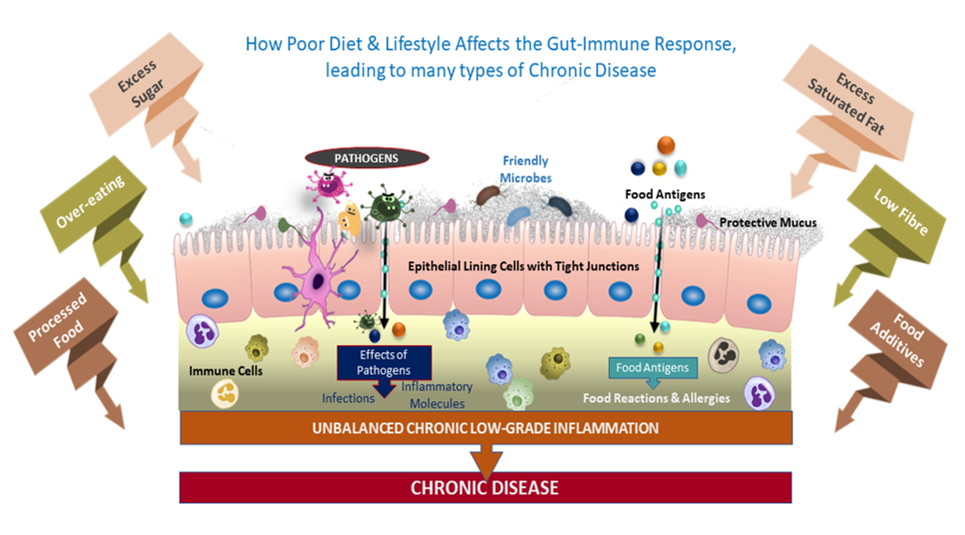
Image credit: Cell Logic Australia
The gut and the immune system
Because much of the body’s immune system is found within the gut - 70-80% of the immune cells are found in this region of the body - it plays a massive role in immune health and chronic inflammation. Many specialised cells are located in this region, including Gut-Associated Lymphoid Tissue (GALT), which helps to guard against harmful substances, whilst also differentiating and recognising ‘safe’ microbes and food antigens in the GI tract; various cell signalling molecules that keep things working smoothly; intestinal cells that support the health of the microbiome and mucous layer; and many microbes that help support and regulate the immune response.
There is constant cross-talk happening between immune cells, intestinal cells, and the microbiome, and they all interact to help create a healthy environment in which digestion happens smoothly, immune surveillance can happen safely, and the body is protected from harm whilst allowing nutrients to be absorbed and the gut to function as it should.
The microbiome
In a healthy gut, you’ll find microbes that help ferment fibre into Short-Chain Fatty Acids that nourish the gut lining and cool inflammation, and microbes that produce substances that neutralise and kill harmful bacteria. There’s a mucosal layer that protects against harmful invaders and chemicals, whilst simultaneously nourishing the ‘good guys’ by providing food for species such as Akkermansia municiphila and Bifidobacterium, which in turn nourish the gut barrier and support gut health. In short, it all works together to allow proper digestion and nourishment to happen, whilst also safeguarding the body from harm.
In a gut affected by dysbiosis, however, you’ll find lower levels of helpful species, and an increase in pathogenic microbes. These produce toxic substances that damage the gut barrier and allow the tight junctions - ‘gates’ between the epithelial cells lining the gut - to become ‘leaky’, allowing substances such as microbes, chemicals, and food antigens to pass through.
Dysbiosis can mean that zonulin - a ‘gatekeeper’ molecule that allows substances such as nutrients to pass through the tight junctions safely - can increase, and allow the junctions to become too relaxed and start to leak. Various pathogenic gram-negative bacteria contain a substance called lipopolysaccharide (LPS) in their outer cell membrane, and while they’re always present in the gut, they are normally contained safely by the mucous layer. However, when the gut barrier becomes leaky, they can slip through, triggering significant inflammation and immune activation, and in turn further damage the gut barrier.
How they fit together
Because the immune cells are primed to ‘attack’ any invading substances in the wrong place, they will launch a response to these harmful chemicals, and inflammation will result. Until you address the underlying ‘leaky gut’, you’re going to struggle to sort out any chronic inflammation.

Red flags for ‘leaky gut’ and inflammation
Autoimmune conditions
Food allergies and intolerances
Reactions to food
Poor digestion and gut problems such as IBS, bloating, constipation, diarrhoea, mucous in the stool, inflammatory bowel diseases
Eczema, asthma and atopic conditions such as hayfever and histamine interolance
Neuroinflammatory conditions
Depression and anxiety
Chronic fatigue, fibromyalgia
Chronic infections
Fatigue, exhaustion, and malabsorption
Nutritional deficiencies
Complex chronic health disorders
How do we fix things?
In my clinic, my number one go-to for healing the gut is the Gut Ecology and Metabolic Modulation (G.E.M.M. Protocol). This utilises nutrition, lifestyle, and targeted food-based nutrigenomic compounds to help correct the microbiome, reduce inflammation, support healthy cross-talk between the gut and immune cells, address immune function, and allow it all to come together properly.
Some basic tips though, for those not doing the programme, are:
Consume a variety of plant-based foods every day, aiming for at least 30 different foods each week. This can include vegetables, fruit, nuts and seeds, grains, seaweeds, etc. Research shows the wider the diet, the more diverse - and thus healthy and stable - the microbiome becomes. A ‘Mediterranean’ style diet has great research to show its effects on healthy gut function.
Ensure you eat plenty of protein. I’m a big fan of animal protein (sorry, vegans!), but you can also include organ meats, eggs, nuts and seeds, and even minimally processed dairy if your body is ok with dairy.
Eat prebiotic foods such as legumes, brown rice, quinoa, chia seeds etc to nourish and feed the microbiome.
Fermented foods can work well for many people to increase microbial diversity.
Get enough sleep - if you can’t sleep, feel free to get in touch, as there are many herbs that can help. Getting into daylight after sunrise, around midday, and at sunset can support circadian rhythm, and remember to switch off screens at least an hour before bed to minimise disruptive blue light.
Nervous system health is vital - make sure you take time to relax, take deep belly breaths, laugh, sing, and do what you can to keep your nervous system healthy and well nourished (which will be a blog for another day!).
Minimise processed foods, especially those high in sugar and refined carbs without any nutrition. These can significantly disrupt the microbiome, damage the mucosal layer, and interfere with healthy immune function and signalling, leading to increased inflammation and pain.
Cut out anything causing obvious reactions. Many people struggle with gluten (which can increase zonulin), dairy proteins, soy, and other allergens.
If any of this is sounding familiar and you’d like more information, or feel like you might be struggling with a leaky gut/intestinal permeability, you’re welcome to book an appointment with me to investigate further and help regain healthy function again, naturally.